Research / University collaboration
How should institutions
delegate authority to AI?
An AI system may identify a sensible action without settling who has the standing to authorize it. Our research examines that gap, how a delegation can be represented in software, and what people need to exercise effective oversight.
Discuss research collaborationResearch paper · 20 October 2026
The Authority Gap
Why Intelligence Alone Cannot Govern Action
An AI system can get the answer right and still have no authority to act. Even valid permissions, approvals, and delivery records can refer to different versions of the same decision.
This paper examines how institutions can preserve the connection between a mandate and the action actually performed—and what they owe people when the outcome remains uncertain.
Read the full paperPDF · 24 pages · Research manuscript
Research agenda
Six connected questions
The work spans philosophy, computer science, and human factors. A philosophical account of delegation needs a different kind of support from a claim about system performance or a reviewer’s decisions.
These are working manuscripts and proposed studies at the stages shown below. We are seeking collaborators to develop and examine the work.
01The Authority Gap
When should a machine-generated judgment count as an act of the organization?
Accuracy, technical access, and authority answer different questions. This paper examines the source of a delegation, the discretion it grants, and the conditions under which others can challenge its use. A correctly followed procedure may still rest on an unjustified rule.
- Current work
- Manuscript available to read · October 2026
- Next step
- Invite critical discussion of continuity of authority, institutional responsibility, and recovery under uncertainty.
- Expertise sought
- Philosophy of authority and AI ethics
02Representing Delegated Authority
What must survive when a delegation moves between people and software?
The source of authority, permitted choices, conditions, and obligations may be represented differently by different components. This work asks which relationships must be preserved and compares the proposed representation with existing authorization and capability approaches.
- Current work
- Working draft; comparative revision needed
- Next step
- Define the abstraction and examine what representative implementations can and cannot express.
- Expertise sought
- Authorization logic and capability systems
03From Thought to Action
Which limits can a system preserve under changing conditions?
A permission may be revoked while work is underway. Two requests may race to use the same authority. A recovery process may encounter stale state. The formal work studies these cases under explicit assumptions, including where the guarantees end.
- Current work
- Working model and proof sketches
- Next step
- Select the most demanding properties and strengthen their verification.
- Expertise sought
- Formal methods and systems security
04Exact Effect Authorization in Practice
What does the implementation achieve, and what does it cost?
The evaluation must compare competent alternatives using the same workflow and action definitions. Preventing unauthorized changes matters, but so do valid work blocked, latency, and the burden of recovery. A simpler arrangement may prove sufficient for a particular use.
- Current work
- Historical manuscript; current implementation evaluation needed
- Next step
- Evaluate a supported build, document the environment, and make the resulting artifacts available for scrutiny.
- Expertise sought
- Systems evaluation and independent replication
05Uncertain Outcomes and Institutional Responsibility
What does an organization owe when it cannot establish what happened?
An unresolved effect can leave a person waiting for an answer or remedy. This paper separates the evidence about the original event from the authority to respond now. A response must account for competing duties and the risk of compounding an earlier effect.
- Current work
- Existing manuscript; focused revision planned
- Next step
- Develop the objection-led analysis of unresolved outcomes and corrective authority.
- Expertise sought
- Ethics and institutional responsibility
06Meaningful Human Authority
Under what conditions can a reviewer exercise real judgment?
A person needs relevant information, time, and permission to refuse or defer. The proposed study examines review displays and incentives together. It would distinguish a justified decision to wait from a failure to act, and measure whether added controls improve judgment or merely add work.
- Current work
- Proposed empirical study
- Next step
- Develop the protocol, ethics review, participant plan, and analysis before collecting data.
- Expertise sought
- Experimental psychology and human-computer interaction
University collaboration
Where another discipline
can change the work
We welcome collaborators who can strengthen an argument, identify a better comparison, or design a study capable of finding that an approach does not help.
A relationship should begin with a question and the expertise needed to answer it. Authorship, publication, access to data and systems, intellectual property, and any required review need to be agreed before the work starts.
- 01
Philosophy and governance
Examine justified delegation, contestability, and the responsibilities of organizations toward people affected by their decisions.
- 02
Computer science and security
Study authorization properties, implementation behavior, failure conditions, and reproducible comparisons.
- 03
Psychology and human factors
Investigate what reviewers understand, the conditions under which they defer, and how incentives affect the decisions they make.
2026 textbook manuscript
The textbook
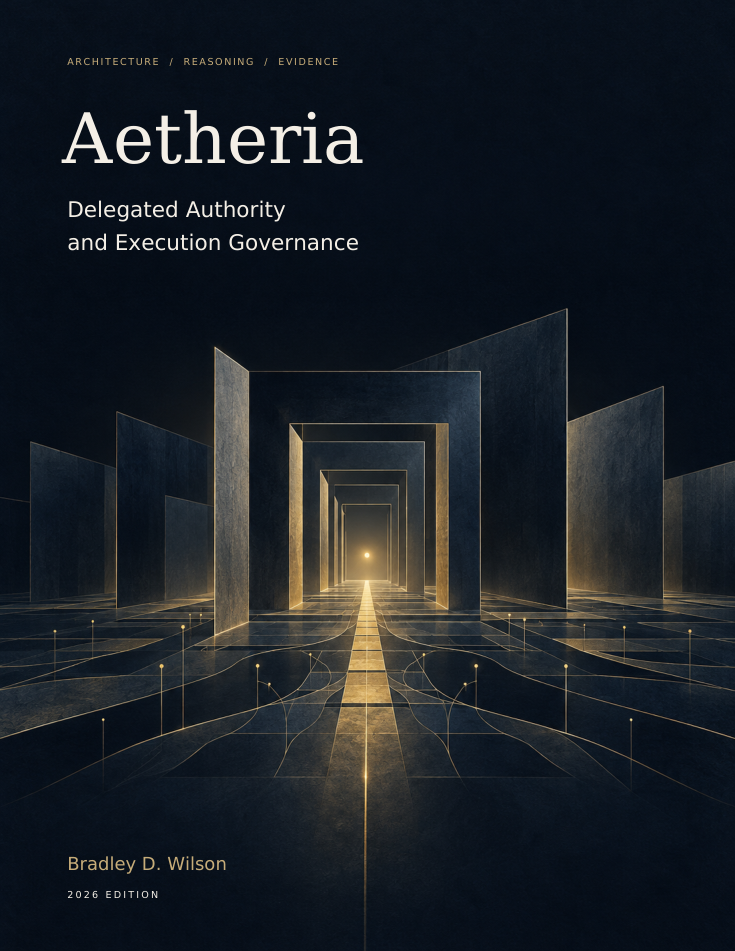
Aetheria: Delegated Authority
and Execution Governance
Bradley D. Wilson’s educational manuscript follows these ideas into the details of a working process: access to information, the action proposed, the person who may authorize it, and the evidence of what happened.
Its 37 chapters use cases, handwritten diagrams, and exercises, with accompanying instructor material. Chapter 1 is available as a free sample. Contact us about purchasing the complete book.
PDF · Chapter 1 sample · 9 pages
Ask about purchasing the full bookMethods and evidence
The result must be
allowed to change the claim.
An argument can fail under an objection. A system can perform well in one setting and poorly in another. An oversight measure can add effort without improving decisions. The methods need to be capable of finding those results.
Each project identifies its contribution and the closest relevant prior work. Comparisons should use capable alternatives under stated conditions.
We distinguish arguments, specifications, simulations, implementation tests, and field observations. Independent replication and peer review are further milestones, not labels for internal checks.
Where the evidence is incomplete, the question remains open.
Inspect the available technical review material